
Agentic AI Is Here: What Business Owners Actually Need to Know
"AI agent" has become one of those phrases that gets thrown around so much it's started to lose meaning.
Every software product is suddenly an agent. Every vendor pitch includes the word. And if you've been in any business tech conversation recently, you've probably nodded along while quietly thinking: what does that actually mean for my company?
That's what this post is for.
No hype. No jargon. Just an honest look at what AI agents are, what they're genuinely capable of right now, and how to tell if your business is actually ready for one.
First, What Does "AI Agent" Actually Mean?
Let's clear this up fast, because the word gets used to describe very different things.
At its core, an AI agent is a system that can take a goal, break it into steps, use tools to complete those steps, and adjust along the way — without a human steering each move.
Think of it this way. A basic AI tool is like a calculator: you give it an input, it gives you an output. A chatbot is one step up: it has a conversation with you. An AI agent is different — you give it a task, and it goes off and does things to complete it. It might search the web, pull data from your CRM, write a draft, send an email, and log the result — all in one flow, without you clicking through each step.
That's the meaningful difference. It's not just answering. It's acting.
The Spectrum: From Simple Automation to True Agency
It helps to think of this as a spectrum rather than a binary.
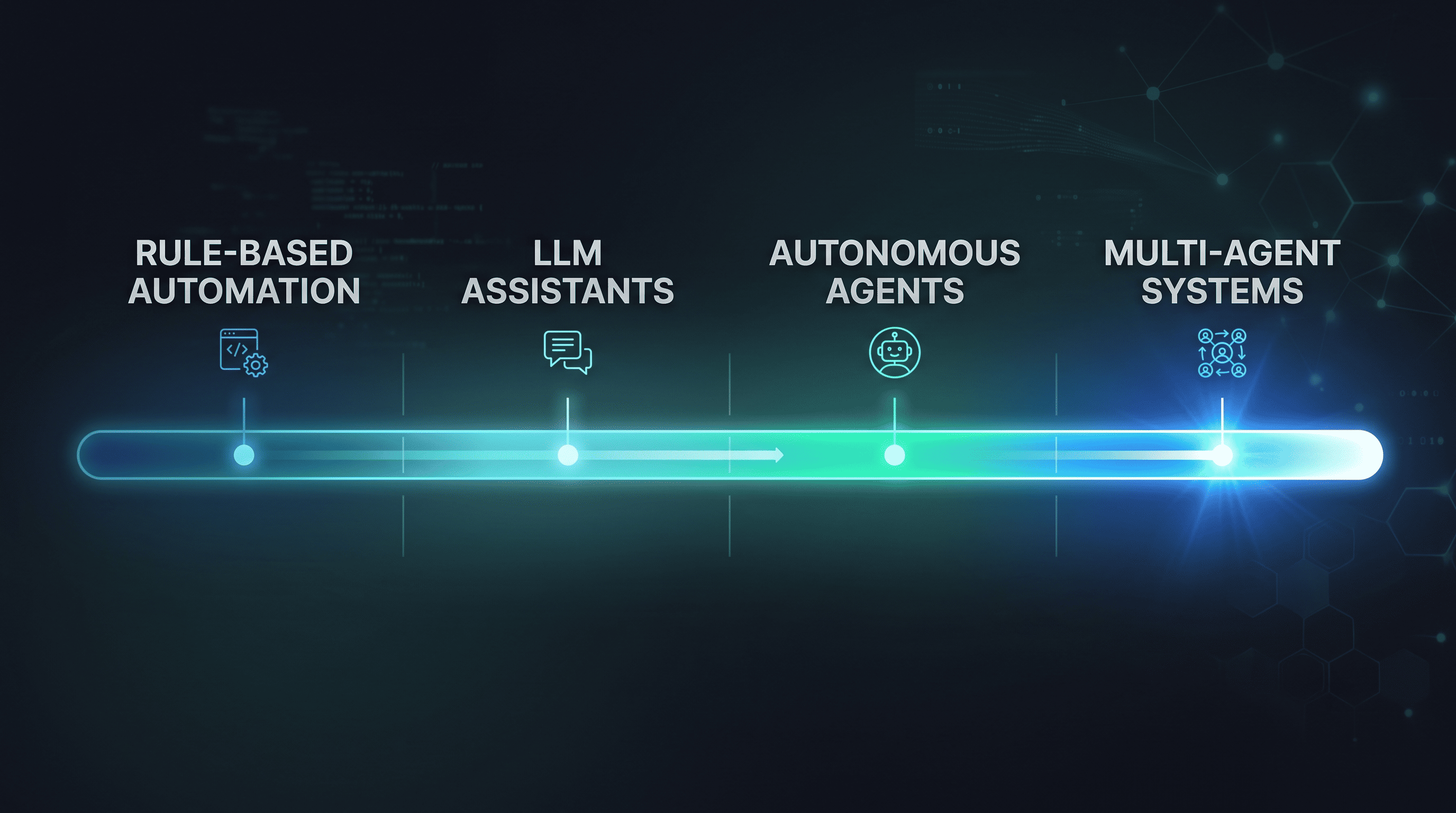
At one end, you have basic rule-based automation — "if this happens, do that." Reliable, predictable, but rigid. Can't handle anything it wasn't explicitly programmed for.
Move along the spectrum and you hit LLM-powered assistants — tools like AI chatbots that can understand language and generate useful outputs, but still require a human to take action based on what they produce.
Further along is where agents live. They can reason over a goal, use multiple tools (databases, APIs, email, calendars, browsers), handle unexpected situations, and take autonomous action across a multi-step process.
At the far end, you get multi-agent systems — multiple AI agents working together, each specializing in a part of a larger workflow, handing tasks off between them. This is newer territory and genuinely powerful, but also more complex to build and maintain.
Most businesses that are getting real value from agents right now are somewhere in the middle of that spectrum — not fully autonomous, but meaningfully more capable than a chatbot.
What AI Agents Are Actually Good At Right Now
Here's where the honest answer matters most. Agents are impressive — but they're not magic, and the use cases that work well share specific characteristics.
They're great at multi-step research and synthesis. An agent can pull information from multiple sources, cross-reference it, and produce a structured output — a competitive brief, a summarized report, a client-ready document — without a human doing each step manually.
They're great at connecting systems that don't talk to each other. Think of the workflows in your business that require someone to copy information from one tool into another. An agent can sit in the middle of that, read from one system, make decisions based on what it finds, and write to another.
They're great at handling volume. Customer inquiries, lead qualification, document processing, support ticket routing — tasks that are repetitive, rule-ish, but just varied enough that traditional automation keeps breaking. Agents handle the variation better.
A real-world example: A professional services firm we worked with had their team spending hours each week pulling project updates from Slack, emails, and their project management tool to compile a client status report. An agent now does it automatically every Friday — reads the relevant conversations, extracts key updates, writes the narrative, and drops it into a formatted doc ready to send. The team reviews it in five minutes instead of building it in two hours.
That's not science fiction. That's running in production right now.
Where Agents Fall Short (And Why This Matters)
Here's the part most vendors skip.
AI agents can fail in ways that are different from traditional software failures — and in some ways more dangerous. Traditional software either works or it breaks visibly. Agents can fail quietly, making decisions that look plausible but are wrong.
A few specific failure patterns to know:
Hallucination in action chains. When an agent gets something wrong in step 2 of a 6-step workflow, steps 3 through 6 all compound that error. The final output can be confidently wrong in ways that are hard to trace.
Unpredictable behavior at edge cases. Agents handle most situations well. But when they hit something genuinely outside their training and instructions, their behavior can be unpredictable. In a customer-facing context, that's a real risk.
Oversight gaps. The whole point of an agent is that it works without you watching every step. But that also means errors can accumulate before anyone notices. Without proper monitoring and logging, problems can quietly snowball.
None of this means agents aren't worth building. It means they need to be designed with guardrails — human review checkpoints, fallback logic, alerting when something looks off. The teams that build agents well spend as much time on failure handling as they do on the main workflow.
Real Business Applications That Are Working Today
Across the businesses we've seen deploy agents successfully, the use cases tend to cluster around a few categories:
- Sales and CRM workflows — Agents that research leads, pull company context, draft personalized outreach, and update CRM records after calls
- Internal knowledge retrieval — Agents that answer employee questions by pulling from internal documentation, past proposals, HR policies, and SOPs
- Operations and reporting — Agents that compile status updates, flag exceptions, and generate formatted reports from live data across multiple tools
- Customer support triage — Agents that handle routine inquiries, pull order or account history, resolve common issues, and escalate complex cases with context already attached
- Document processing — Agents that extract, classify, and route information from contracts, invoices, applications, or intake forms
The businesses getting the most value from these aren't the largest ones. They're often mid-sized companies where a lean ops team is doing the work of a much larger one — and an agent is the equivalent of hiring three people who never sleep and never make copy-paste errors.
Is Your Business Ready for an Agent?
Not every business is. And jumping in before you're ready wastes time and money.
A few questions worth being honest about before you pursue an agent-based project:
Is the workflow well-defined? Agents work best when there's a clear goal, clear inputs, and clear success criteria. If the process is fuzzy even for your human team, an agent will amplify that fuzziness.
Do your systems have accessible APIs? Agents need to connect to your data. If your tools are locked down or have poor integration options, you'll spend the entire budget on integration work before the agent does anything useful.
Are you ready to maintain it? Agents aren't set-and-forget. They need monitoring, adjustment as your business changes, and someone accountable for their performance. If there's no plan for ownership post-launch, the system will drift.
What's your risk tolerance for errors? Some workflows are fine with occasional mistakes — a first draft that needs editing, a report that gets reviewed before sending. Others aren't — anything customer-facing, financial, or compliance-related needs much tighter guardrails. Know which category your use case falls into.
If you can answer all four comfortably, you're in good shape to move forward.
The Honest Bottom Line
AI agents are real, they're useful, and the businesses that are building them thoughtfully are getting genuine competitive advantages — not in a theoretical future, but right now.
But the operative word is thoughtfully. An agent built on an unclear workflow, shaky data, or without proper fallback design will either disappoint you or create problems you didn't anticipate.
The companies winning with agents aren't the ones that moved fastest. They're the ones that picked the right use case, understood the limitations going in, and built with the failure modes already accounted for.
That's a slower start — and a much better outcome.
Thinking About Building an AI Agent?
If you have a workflow in mind — something repetitive, multi-step, and eating up more of your team's time than it should — we're happy to talk through whether an agent makes sense for it.
We'll give you a straight answer. If it's the right fit, we'll show you exactly what it would take to build it properly. If it's not, we'll tell you that too and point you somewhere more useful.