
Why AI Implementation Projects Fail: A Consultant's Honest Breakdown
If you've been paying attention to the business world over the last couple of years, you've probably heard a version of this story:
A company invests heavily in an AI project. There's excitement. There's a launch. And then… not much. The tool goes underused, the results disappoint, and six months later everyone quietly agrees to stop talking about it.
This isn't rare. It's actually the norm.
Depending on which research you read, somewhere between 60% and 85% of enterprise AI projects fail to reach production or don't meet their original goals. And for the projects that do launch, a large chunk don't deliver the ROI that was promised in the proposal.
Here's the thing though — the technology isn't usually the problem.
After working on AI implementations across different industries and business sizes, the failures we've seen almost always come back to the same handful of avoidable mistakes. Not bad models. Not bad technology. Bad decisions made before a single line of code was written.
So let's talk about them honestly. Because if you're planning an AI project — or evaluating one — knowing these failure modes might be the most valuable thing you can read.
Why Most AI Projects Fail Before They Start
Here's something most AI vendors won't tell you upfront: the probability of your project succeeding is largely determined in the first few weeks of discovery, not during the build.
The code is the easy part. The hard part is knowing exactly what to build, why it's worth building, and whether your business is actually ready to support it.
Most projects fail because they skip that hard work.
Let's go through each failure mode one by one.
Failure Mode 1: Solving the Wrong Problem
This is the most common one, and it's sneaky because it doesn't look like a problem at first.
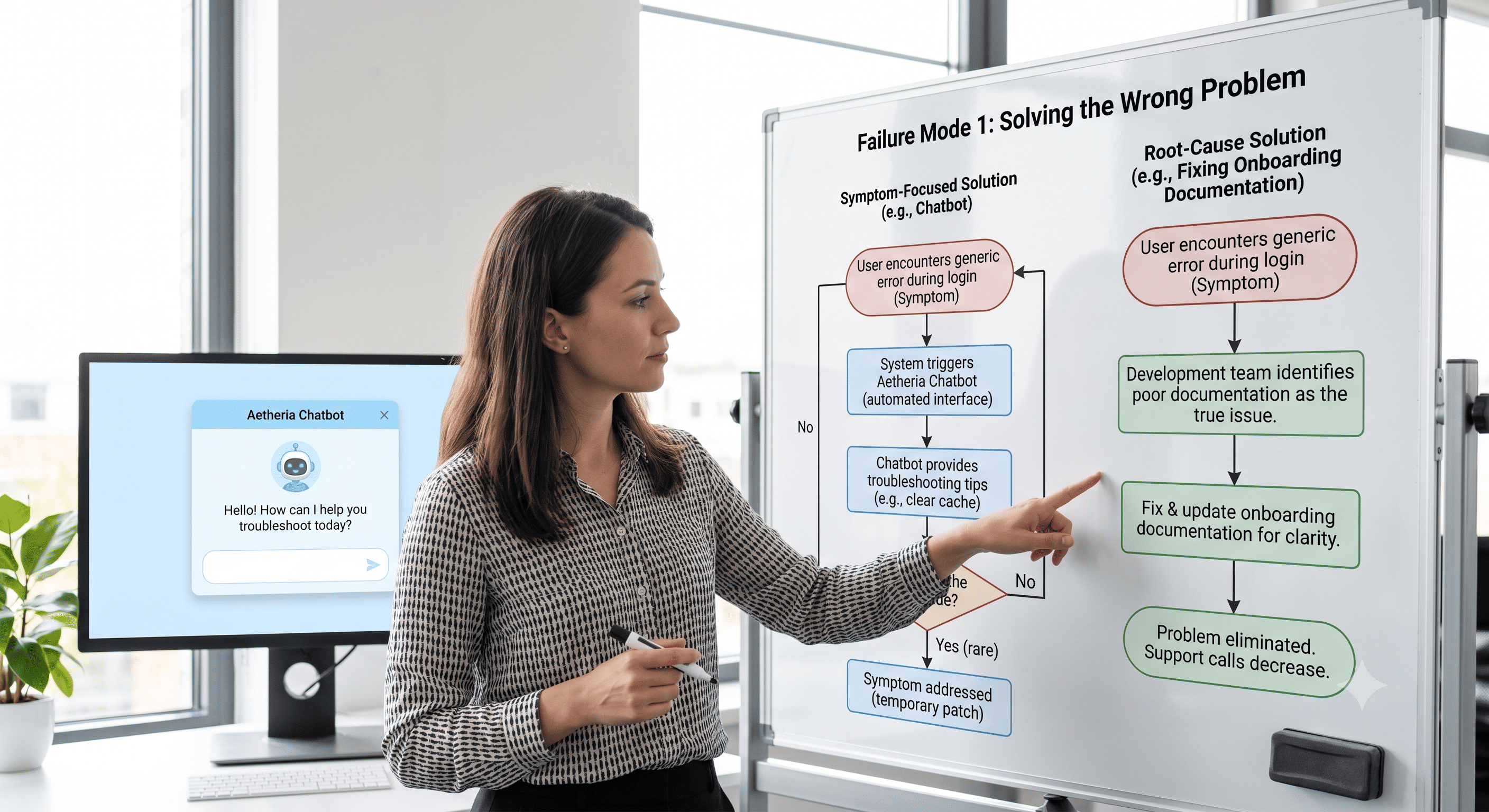
A business leader comes in with a clear request: "We need an AI chatbot for customer service." Or "We want AI to automate our reporting." The team nods, starts scoping, and builds exactly what was asked for.
Six months later, the chatbot is live — and customer satisfaction scores are the same. Why? Because the real problem wasn't that customers weren't getting fast enough answers. It was that the product documentation was confusing and customers were asking the same questions because the onboarding flow had a gap.
An AI chatbot answered the symptom. The actual problem went untouched.
The fix: Before deciding what to build, spend real time understanding why the problem exists. Ask questions like: What's causing this in the first place? What would the business look like if this problem disappeared tomorrow? If you can solve this without AI, should you?
Sometimes the answer to the last question is yes. And a good partner should be willing to tell you that.
Failure Mode 2: Garbage In, Garbage Out (And Nobody Checked the Garbage)
Every AI system — whether it's a chatbot, an automation workflow, or a predictive model — is only as good as the data feeding it.
This sounds obvious. Everyone nods when they hear it. And then companies spend months building an AI system on top of incomplete, inconsistent, or poorly labeled data — and wonder why the outputs are unreliable.
Here's a real scenario that plays out constantly: A company wants to build an AI assistant trained on their internal knowledge base. Great idea. They pull together documents, PDFs, and wiki pages. Except:
- Half the documents are outdated and haven't been touched in three years
- The file naming is inconsistent, so similar topics live in completely different places
- Some critical knowledge is only in people's heads, never written down
- Pricing and policy information contradicts itself across documents
The AI faithfully learns all of it. Then it confidently gives customers wrong answers.
The fix: A proper data audit should happen before any AI project kicks off. That means understanding what data you have, how complete it is, how clean it is, and whether it actually reflects how your business operates today. This work is unglamorous. It's also non-negotiable.
Failure Mode 3: Technical Success, Zero Adoption
This one is heartbreaking to watch.
The system works. The demos are impressive. The engineers did their job. And then the team keeps doing things the old way.
This happens more than you'd think. A new AI tool gets built, it gets "launched," and adoption is left to chance. No training. No change management. No conversation about why this is better than the way people already work. The people who were supposed to use it never really got onboard, and the tool slowly becomes shelf ware.
The reason this happens is that AI projects are almost always framed as technology projects. They're not. They're people projects that happen to involve technology.
Think about it from the employee's perspective. They've been doing their job a certain way for years. It works well enough. Now someone is asking them to learn something new, trust outputs from a system they don't fully understand, and change their workflow — with no clear explanation of what's in it for them.
Without a real plan to bring people along, even the best-built AI system will fail.
The fix: Treat change management like a deliverable, not an afterthought. Who are the people whose daily work will change? What are their concerns? Who are the internal champions who can help build trust? Plan for training, feedback loops, and a ramp-up period where people can build confidence before they're fully relying on the tool.
Failure Mode 4: Scope Creep Disguised as Iteration
This one is tricky because it feels like good, responsive teamwork while it's happening.
The project starts with a clear, focused scope. Then someone has a good idea. "While we're at it, could we also add…?" And another good idea. And another. Each addition seems reasonable. Each one is genuinely useful. But six months into a three-month project, you have a bloated system that's half-built in ten directions instead of fully built in one.
The irony is that scope creep almost always comes from enthusiasm, not bad intentions. The business sees potential and wants more. That's actually a good sign. But if it isn't managed carefully, you end up with something that's impressive in breadth and underwhelming in depth — and doesn't deliver what you actually needed.
The fix: Define success clearly before you build. What specific problem does this solve? How will you know it's working? What is explicitly out of scope for version 1? Get these decisions in writing before the project starts, and create a clear process for how new ideas get evaluated — not automatically rejected, but intentionally considered rather than casually added.
Failure Mode 5: The Proof-of-Concept Trap
This is one of the most expensive mistakes a business can make.
A vendor builds a slick demo. The AI answers questions accurately, the automation runs smoothly in the test environment, the interface looks polished. The business approves the budget, the project kicks off, and then the real-world results don't match what the demo showed.
Why? Because demos and proofs of concept are optimized to impress, not to handle the messy reality of a real production environment. They're run on curated data, in controlled conditions, without the edge cases, legacy system quirks, data quality issues, and user behavior variations that exist in actual operations.
Going from "this works in a demo" to "this works reliably for our customers every day" is a significant engineering and design challenge. Many teams — and many vendors — underestimate how big that gap is.
The fix: When evaluating any AI vendor, don't ask to see demos. Ask to speak with customers who are running the system in production. Ask what changed between the POC and the live product. Ask what broke. Any agency worth working with will have honest answers to those questions. If they only want to show you demos, that tells you something.
Failure Mode 6: The Wrong Build Partner
The AI industry has exploded in the last couple of years, and so has the number of "AI agencies." Some of them are genuinely experienced. Many of them are not.
The challenge for buyers is that it's hard to tell the difference from the outside. Everyone has polished websites. Everyone talks about LLMs, automation, and business transformation. Everyone has case studies (even if they're vague).
But building AI systems that actually work in production — that are reliable, secure, well-integrated, and maintainable — requires a specific kind of experience. You can't fake your way through it. Teams that relabeled themselves as AI agencies after a few months of learning the tools don't have the pattern recognition to know what will go wrong, because they haven't seen it go wrong yet.
The result is projects that look fine until they don't. Systems that work in testing and break in production. Architectures that aren't designed for scale or maintenance. And a client who's left holding the bag when the cracks start to show.
The fix: Ask for evidence, not credentials. Not certifications. Not partnership logos. Not testimonials. Ask to see live systems they've built that are still running. Ask what the hardest technical decision was on a recent project and why they made it. Ask what they'd do differently. The answers will tell you everything you need to know.
Failure Mode 7: No Ongoing Ownership Model
Here's something that almost never makes it into the proposal: AI systems require ongoing maintenance to stay good.
Models drift. The world changes. Your business changes. Your data changes. A system that was 92% accurate when it launched might be 74% accurate eighteen months later if nobody's been tending to it. And in many cases, nobody notices until there's a problem.
This happens because AI projects are often treated like traditional software projects. Build it, test it, launch it, move on. But AI systems aren't static. They're dynamic — their performance is tied to the data they were trained on, the instructions they were given, and the world they're operating in. All of those things change over time.
If there's no plan for who monitors the system, how performance is measured, when retraining or updates happen, and what the escalation path looks like when something goes wrong — the system will eventually degrade without anyone realizing it.
The fix: Before you launch anything, define the ownership model for after launch. Who monitors performance? What metrics matter and how often are they reviewed? What's the threshold that triggers a review or update? This doesn't have to be complicated, but it has to exist.
The Pre-Project Diagnostic: 8 Questions to Ask Before You Start
Before you kick off any AI initiative — or sign any contract — go through these questions with your team:
- Can we articulate the specific problem in one sentence? If you can't, the scope isn't clear enough yet.
- Do we know what "success" looks like six months from now? Define measurable outcomes before you build, not after.
- Have we audited the data we'd need to power this? Clean, complete, current data is the foundation. Don't assume it's there.
- Who will use this system, and have we talked to them? The people whose work will change need to be part of the conversation from the start.
- Who owns this after launch? Name the person or team responsible for monitoring and maintaining it.
- Do we have executive sponsorship? Without a champion at the leadership level, the project will stall when the first obstacle appears.
- Are we budgeting for the full lifecycle, or just the build? Maintenance, updates, and iteration are ongoing costs. Plan for them.
- Is our partner showing us live systems or demos? The answer tells you a lot.
If you can answer all eight confidently, you're better positioned than most organizations that start AI projects.
The Honest Bottom Line
AI is genuinely transformative. The use cases are real, the ROI is achievable, and the businesses using it well are pulling ahead of those that aren't.
But the failure rate is high because most organizations treat AI like magic — something you plug in and it works — rather than what it actually is: a complex, multidisciplinary system that requires clarity, preparation, good partners, and ongoing attention.
The good news is that failure is preventable. Not with expensive insurance policies or massive consulting retainers. Just with honest discovery, careful preparation, and a partner who will tell you the truth about what you need before they tell you what they can sell you.
That's the standard every AI project deserves.
Thinking About an AI Project?
If you're at the stage where you're considering an AI initiative — or you've already tried one and didn't get the results you expected — we're happy to have an honest conversation about what's realistic for your situation.
We do a structured discovery process before any project starts, specifically because we've seen what happens when that step gets skipped. Sometimes the conversation confirms what you came in thinking. Sometimes it leads somewhere more valuable.
Either way, you'll leave with a clearer picture than you came in with.