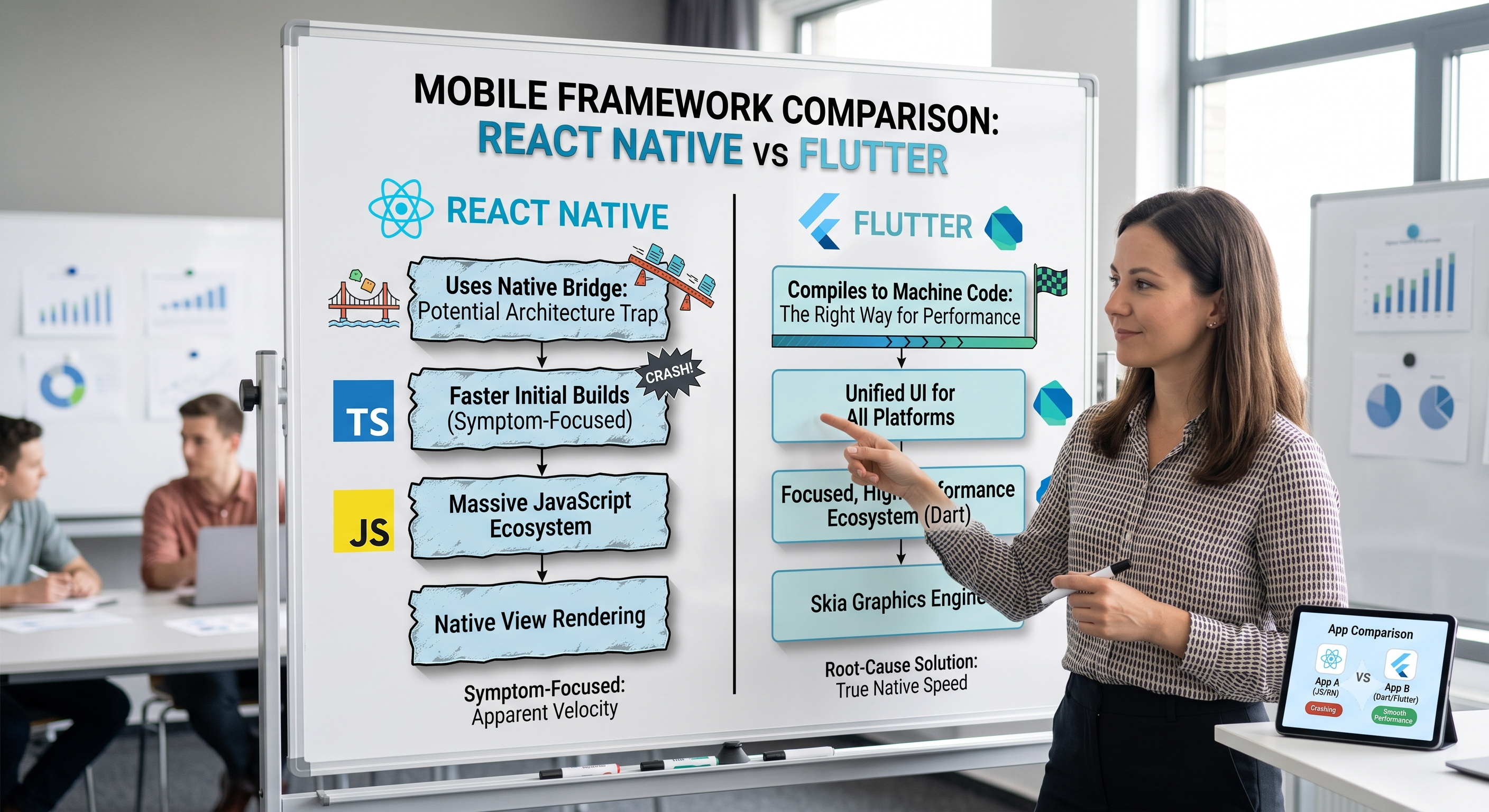
React Native vs Flutter in 2025: What We Choose and Why
We get this question every week. "Should we use React Native or Flutter?" Our answer is always the same: it depends. But not in a consultant way — in a specific, conditions-matter way.
Where React Native wins
Your team knows JavaScript. React Native is JavaScript. TypeScript if you're doing it right. If you already have a web team on React, you can share engineers, share business logic, and dramatically reduce the ramp-up time for a mobile build.
You're building a business application. CRMs, dashboards, internal tools, B2B SaaS mobile companions — these don't need pixel-perfect animations or cutting-edge device access. React Native handles them cleanly, and the ecosystem of libraries (navigation, state, forms) is mature.
You need to integrate with web infrastructure you've already built. If you have a Next.js web app and a Node.js API, React Native slots in naturally. One team, one stack, one set of patterns.
Where Flutter wins
Your team knows Dart (or is starting fresh). If you're building a greenfield mobile app with no existing web codebase and no existing team constraints, Flutter's opinionated widget model produces more consistent UI behavior across platforms.
You need pixel-perfect custom UI. Flutter renders everything itself using its own rendering engine (Impeller/Skia). That means what you design in Figma is what you get on screen — on every device, every OS version. React Native still defers to native components in some cases, which can produce subtle inconsistencies.
Your app involves complex animations or games. Flutter's animation system is lower-level and more controllable. If you're building something with custom gesture-driven animations, Flutter gives you more control.
Where they're equivalent
- Performance: Both are close enough for the vast majority of business applications. Neither will win a benchmark against fully native code for computationally intensive tasks.
- Maintenance cost: Both require framework updates, both have breaking changes, both need someone who knows the ecosystem.
- Community support: Both are mature enough that Google is the first result for most problems.
Our default recommendation
For a new business application where the client has an existing React/JavaScript team: React Native.
For a greenfield consumer app where design polish and animation quality are core to the product's value proposition: Flutter.
For anything that's primarily a web product with a mobile extension: React Native, because the overlap between web and mobile codebases is a real advantage.
What we won't say
We won't tell you either one is "the future" or that the other one is dying. Both are actively maintained by major companies (Meta and Google) with hundreds of contributors. Both will be viable choices in 2026.
What matters is the specific constraints of your project — team, timeline, product type, and design requirements. Those conditions produce the right answer, not the framework hype cycle.