
How We Approach MVP Development for Funded Startups
You've raised your round. Congratulations — genuinely.
Now comes the part nobody warns you about: the pressure to turn that capital into a product, fast, without making decisions you'll spend the next two years undoing.
We've worked with enough funded startups to know that the post-raise window is one of the most critical — and most mishandled — phases of building a company. Everyone is watching. Your investors want proof the bet was right. Your early customers want the thing you promised them. Your team is excited and wants to start building immediately.
And in the middle of all that noise, you have to make the most important technical decisions of your company's early life.
This post is about how we think about MVP development in that context — what we've learned works, what founders typically get wrong, and the approach we take when we're brought in to help build it right.
The Word "MVP" Gets Misused Constantly
Before anything else, let's agree on what an MVP actually is — because we've seen two equally destructive misinterpretations of it.
The first is the "it just needs to work" trap. Founders interpret "minimum viable" as license to build something barely functional, ship it, and call it done. The result is a product that creates a terrible first impression with early users, generates noise rather than signal, and quietly damages the brand before it's even established.
The second is the opposite problem: scope creep from day one. Founders raise money, suddenly have a budget, and the feature list starts growing. Every stakeholder has an opinion. "While we're building it, can we also add…?" Six months and most of the runway later, the product still isn't live.
A real MVP is neither of those things. It's the smallest version of your product that genuinely solves the core problem for a specific user — well enough that those users come back, tell other people, and give you feedback worth building on.
Small scope. Real quality. Clear focus.
The First Thing We Do Isn't Design or Code
When a funded startup comes to us for MVP development, the first thing we spend time on isn't wireframes, tech stack decisions, or timelines.
It's a single question: what does this product have to do — and only do — to prove the core hypothesis?
Because a funded startup isn't just building a product. It's building evidence. Evidence that the problem is real, that your solution works, that people will pay for it, and that the unit economics make sense. Every feature you add that doesn't contribute to proving that hypothesis is burning runway on noise.
So we push hard on scope in the early discovery phase. Not to be difficult — but because we've watched teams build the wrong things beautifully, and it's one of the most expensive mistakes you can make with investor money.
This usually involves sitting with the founding team and going through every proposed feature with a simple filter: which hypothesis does this test, and how will we know if it passes? Anything that can't answer that question clearly gets pushed to v2.
It's a sometimes uncomfortable process. It's also the thing that most separates startups that get to a second round from those that don't.
Speed Matters — But Not the Way Most People Think
Every funded founder wants to move fast. That's the right instinct. But "fast" gets misunderstood as "start coding immediately."
In our experience, the fastest path to a live product that works is spending two to three weeks doing discovery and architecture work before anyone touches the codebase. Counter-intuitive, but true.
Here's why: the most expensive problems in software development aren't bugs. They're wrong assumptions baked into the architecture early that force a partial or full rebuild later. We've seen startups lose four months and hundreds of thousands of dollars rebuilding systems because a fundamental data model decision was made in week one without enough thought.
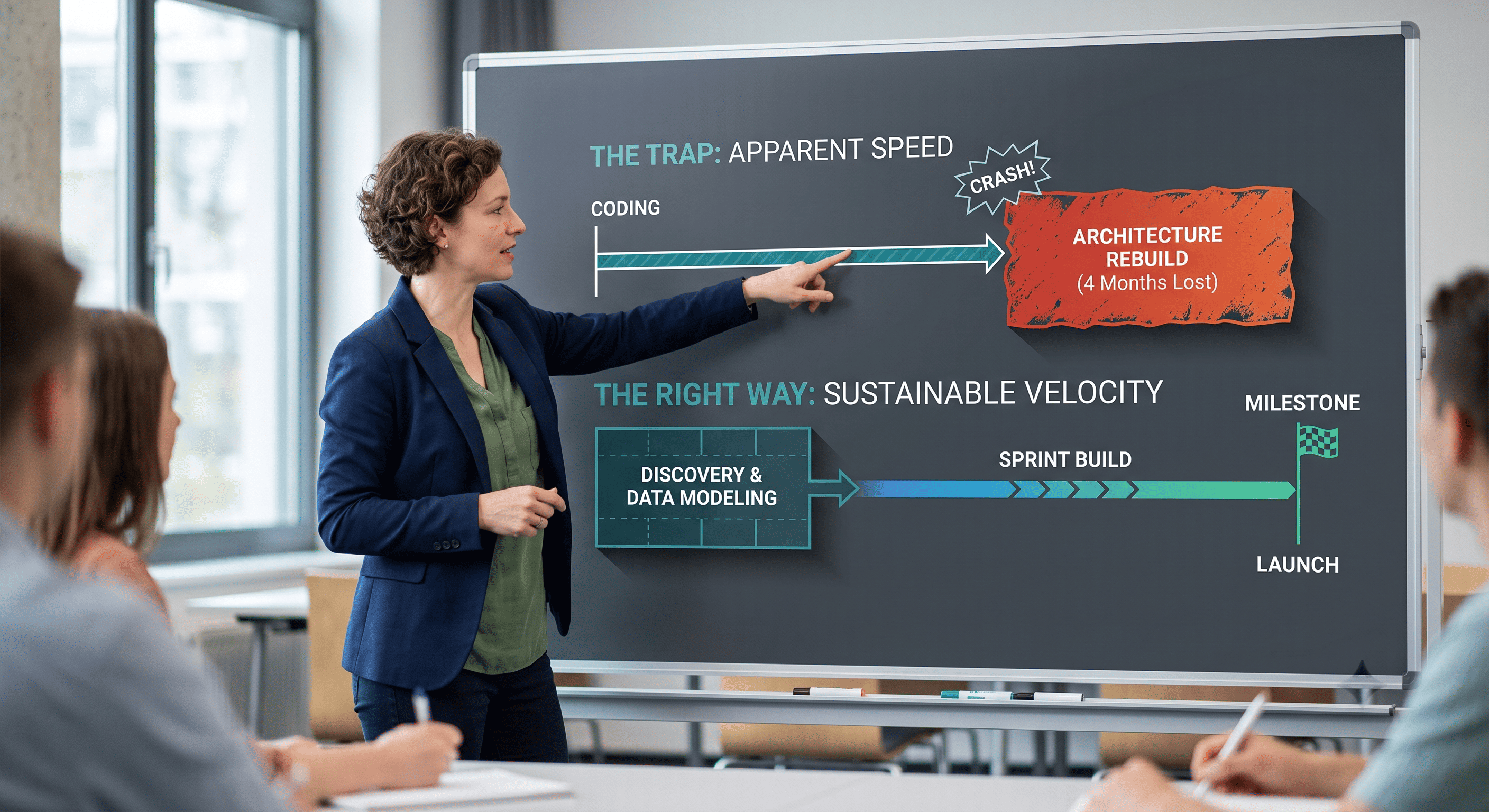
Two weeks of structured discovery — user flow mapping, data model design, integration planning, tech stack decisions — eliminates most of those landmines. The build phase that follows is faster, cleaner, and produces something you can actually scale from, not just demo from.
Fast isn't starting immediately. Fast is not having to restart.
How We Actually Structure the Build
Once discovery is done, we move into a build process structured around short, shippable cycles — typically one to two week sprints where something real gets completed and reviewed, not just worked on.
We're intentional about the order we build things in. The core user journey comes first — the thing a user does from landing on the product to getting the core value. Everything else is secondary until that loop works end-to-end. It's tempting to build the settings page, the admin dashboard, the notification system. We push those back until the thing that matters most is solid.
We also build for the demo as much as the user. This isn't cynical — it's realistic. Funded startups need to show investors progress, close early customers, and often raise again before they've reached full scale. A product that works beautifully in a focused demo builds momentum. A product that's technically complete but hard to show kills it.
That means clean interfaces, smooth core flows, and zero embarrassing rough edges in the critical path — even in an early version.
The AI Question
Almost every funded startup we talk to right now is thinking about where AI fits into their product.
Sometimes the answer is "it's the core of everything." Sometimes it's "it makes one specific thing meaningfully better." Sometimes, honestly, it's "you don't need AI in v1 — nail the core workflow first."
We're not going to push AI into a product that doesn't genuinely benefit from it just because it's the moment for it. But when it does fit, we know how to integrate it in ways that actually work in production — not just in demos.
The important distinction for MVP stage is between AI features that are core to the value proposition and AI features that are nice enhancements. If AI is core — an AI-powered workflow, an intelligent assistant, automated decision-making — it needs to be designed into the architecture from day one, not bolted on later. If it's an enhancement, it can wait for v2 when you have real user data to inform how it should work.
Getting this distinction wrong costs a lot of time and money. We help founders think it through clearly before the first line of code is written.
What Investors Actually Want to See
Here's something we've observed working closely with funded startups: what investors say they want and what actually gives them confidence aren't always the same thing.
They say they want growth metrics. What actually moves the needle in early conversations is evidence of learning. A product that launched, gathered real user behavior data, adapted based on it, and is now on version 2 of its core flow tells a much more compelling story than a product that spent eight months building a feature-complete v1 that nobody has touched yet.
The MVP mindset maps directly onto this. Ship something real, to real users, and start generating signal — even if it's imperfect. Then show investors a roadmap built on actual user feedback, not assumptions.
That pattern — build, learn, iterate — is what separates funded startups that raise again from those that go quiet after the seed round.
A Few Things We've Learned the Hard Way
A short list of lessons that have come from watching enough MVP builds succeed and fail:
Don't build for the enterprise customer in your pipeline. It's tempting to add the security certifications, the admin controls, the custom reporting they asked for. Ship the core product first. Land them on that. Customize after.
Your tech stack should match your team, not your ambitions. Choosing a cutting-edge stack because it's exciting is a great way to create a maintenance problem the moment a developer leaves. Choose boring, proven technology unless there's a specific reason not to.
Launch before you feel ready. Every founder we've worked with has wanted one more thing before they go live. That impulse is usually just fear wearing the costume of quality control. Ship it. The feedback you get in week one of being live is worth more than another month of internal refinement.
Build the feedback loop before you need it. Analytics, session recording, a way for users to tell you what's broken — these aren't afterthoughts. They're what turn your MVP from a product into a learning machine.
Ready to Build?
If you've recently raised and you're figuring out how to turn that capital into a product that works, we'd love to talk.
We bring the same structured, no-fluff approach to every MVP engagement — clear scope, fast timelines, honest advice about what to build and what to leave for later.
One conversation is usually enough to figure out if we're the right fit.